
Wings Wings

10 Best LPG Forklifts for Sale in 2026

Time:2026-11-13 Author:Madeline
0%

Choosing among the 10 Best LPG Forklifts for Sale in 2026 takes more than comparing lift capacity and asking price. A Lpg Forklift can suit mixed indoor and outdoor work, especially where quick refuelling matters. But fuel use, ventilation, operator comfort, and local service support can change the real cost of ownership.

Reliable comparisons start with operating conditions. The U.S. Department of Energy’s Alternative Fuels Data Center explains propane’s fuel properties and vehicle applications. The Energy Information Administration’s Short-Term Energy Outlook provides context on fuel markets, though it cannot predict a particular truck’s hourly cost. OSHA’s Powered Industrial Trucks guidance also highlights the need to manage exhaust and ventilation where combustion-powered equipment operates. These sources help frame the decision; a site trial still matters.

Look closely at rated capacity, mast height, turning radius, tire type, and fuel-cylinder access. Check whether the stated lift rating applies at the mast height your warehouse actually needs. Ask dealers for maintenance intervals, parts availability, warranty terms, and fuel-consumption records from comparable duty cycles. Small details count. A truck that looks strong on paper may struggle in a narrow aisle or during long, cold shifts. And published figures are not always directly comparable. This guide weighs those practical limits alongside specifications and ownership support, while treating advertised claims with care. Some listings leave out useful test conditions. That is worth questioning. The best choice is not automatically the newest or cheapest model; it is the forklift that safely matches your workload, operators, and site.
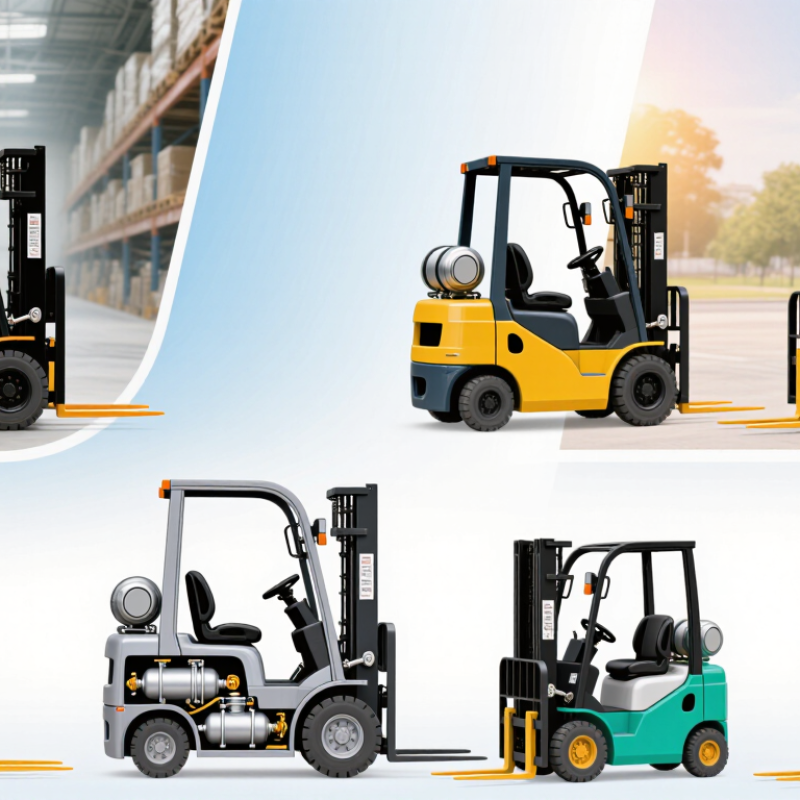
10 Best LPG Forklifts for Sale in 2026

How LPG Forklifts Work and Where They Are Used

An LPG forklift stores liquefied petroleum gas under pressure in a removable cylinder. During operation, fuel flows through a regulator and mixes with air before spark ignition drives the engine. The cylinder can be exchanged quickly, which helps keep busy shifts moving. A practical detail: cold weather and heavy lifting can affect fuel use and engine performance.

These trucks are common at loading docks, lumber yards, and warehouses that need outdoor-to-indoor flexibility. They can produce exhaust indoors, so ventilation and maintenance matter. OSHA sets carbon monoxide’s permissible exposure limit at 50 parts per million over an eight-hour workday (29 CFR 1910.1000). That matters. LPG is not emission-free, and a quiet-looking warehouse can still have poor air quality. Operators should not treat open doors as a substitute for checking ventilation.

Tips: Check cylinder condition, fuel connections, and exhaust systems before each shift. Use carbon monoxide monitors where indoor operation is planned, and follow the manufacturer’s ventilation guidance. The trade-off is easy to underestimate: quick refueling is useful, but it does not remove exhaust risks.

Key Factors for Evaluating LPG Forklifts in 2026

Evaluating an LPG forklift starts with the load, not the advertised capacity. Record the heaviest pallet, its load-center distance, and the highest shelf before comparing machines. Then check the capacity plate at that lift height; attachments can reduce usable capacity. Small details matter. The U.S. Department of Energy’s Alternative Fuels Data Center lists propane at 84,250 Btu per gallon, versus 112,114 for gasoline. These fuel-property figures are not forklift efficiency ratings, but they warn against comparing price per gallon alone. Track cylinder changes, idle time, and shifts per refill during a real workweek.

Indoor air and service access deserve equal weight. NIOSH’s Pocket Guide sets carbon monoxide recommended exposure limits at 35 ppm over a workday and a 200-ppm ceiling. Assess ventilation and measure exhaust exposure, especially in tight aisles. Ask about maintenance intervals, local technician coverage, tire options, and capacity with the intended attachment. Inspect the engine bay after a warm shift; heat, odor, or hard starting may reveal issues a brochure misses. Keep records. The figures are useful, not decisive: operator habits and long idling vary by site. Pilot the truck on the actual route before ordering.

10 Best LPG Forklifts for Sale in 2026: Key Factors for Evaluation

Compare common nominal load-capacity classes when shortlisting LPG forklifts. Capacity alone is not a buying recommendation: check the rated capacity at the required load center, lift height, attachment, and operating conditions.

These are representative capacity classes, not a ranking of specific models. Actual rated capacity varies by forklift configuration and is stated on the manufacturer’s capacity plate.

Ten LPG Forklift Models to Consider for Sale in 2026

Choosing among ten LPG forklift models for sale in 2026 starts with the worksite, not the brochure. Consider a 1.5-ton compact truck for light pallet handling, or a 1.8-ton three-wheel model for tighter aisles. A 2-ton four-wheel model offers a common warehouse configuration. Cushion tires suit smooth floors; pneumatic tires are better suited to uneven outdoor surfaces. Small details matter. A 2.5-ton cushion-tire model, a 2.5-ton pneumatic model, and a 3-ton standard truck cover different floor and load conditions. For higher stacking, consider a 3-ton high-mast configuration. A 3-ton long-wheelbase model may feel steadier with bulky loads, while 3.5-ton and 4-ton options suit heavier handling. A 5-ton industrial model is worth assessing only when its capacity matches regular loads.

Rated capacity depends on the load center, mast height, and fitted attachments. A sideshifter or clamp can reduce usable capacity, so check the data plate and ask for a load chart for the exact configuration. I would not choose by capacity alone; it is easy to overlook turning space and operator visibility. Compare fuel use, service access, tire type, and local parts availability with the expected duty cycle. Ask to inspect a cold start and test the truck with a representative load. A short demonstration helps, though it cannot replace a qualified inspection. Check the plate. A well-matched, used forklift may serve better than a larger truck that spends most shifts underutilized.

Comparing Capacity, Performance, Safety, and Operating Costs

When comparing the 10 best LPG forklifts for sale in 2026, start with the load, not the advertised maximum capacity. Check rated capacity at the specified load center, then consider attachments, mast height, and how often loads are carried near the limit. A forklift rated for 5,000 pounds may have less usable capacity with a sideshifter or extended forks. Small details matter. Measure the narrowest aisle and the actual pallet before choosing.

Performance depends on more than engine power. Compare acceleration on ramps, lift speed under load, visibility through the mast, and how quickly operators can replace a cylinder during a shift. OSHA’s powered industrial truck guidance cites estimates of about 85 forklift-related fatalities and 34,900 serious injuries annually in the United States. Those figures make practical safety features worth close inspection: clear sightlines, stable handling, accessible controls, and seat restraints. A test drive with a representative load can reveal issues a specification sheet misses.

Operating costs vary with local LPG prices, duty cycle, and maintenance support, so calculate fuel use per operating hour rather than relying on broad estimates. Include cylinder handling, scheduled servicing, tires, and downtime in the comparison. The U.S. EPA’s greenhouse-gas emission factors put propane combustion at roughly 5.75 kilograms of carbon dioxide per U.S. gallon. That figure does not capture every operating impact, but it gives buyers a consistent fuel-use reference. Prices change. Get written fuel and service estimates for your site.

How to Choose an LPG Forklift for Your Workplace

Choosing an LPG forklift starts with the worksite, not the advertised lift capacity. Measure your heaviest pallet, then account for the attachment and load center; a long load can reduce safe capacity. Check aisle width, floor condition, ramp gradient, and hours per shift. LPG refueling is quick, but cylinders need secure outdoor storage and trained handling. For indoor work, assess ventilation and monitor carbon monoxide, especially near loading bays. A cold morning can change how the truck starts. Small details matter.

OSHA estimates that forklifts cause about 85 deaths and 34,900 serious injuries annually in the United States. That figure makes visibility, braking, stability, and operator training practical buying criteria—not optional extras. OSHA’s powered industrial truck standard also requires examinations before service, at least daily, so ask about inspection access and routine maintenance. Compare fuel use under your actual load cycle, not a sales estimate. I would not choose on fuel cost alone; that shortcut may look tidy on paper and disappoint on a busy shift. Leave room in the decision for a workplace trial, and verify capacity against the manufacturer’s data plate.

10 Best LPG Forklifts for Sale in 2026 — How to Choose an LPG Forklift for Your Workplace
Option Typical Rated Capacity Typical Lift-Height Range Best-Fit Workplace Typical Tire Choice Key Advantage Check Before Buying
Compact LPG counterbalance 1.5–1.8 tonnes About 3–5 m Small warehouses, workshops, and light-duty loading areas Cushion tires for smooth floors; pneumatic tires for suitable outdoor surfaces Small-capacity option for lighter loads and tighter work areas Confirm turning space, overhead clearance, and capacity at the required lift height.
Light-duty warehouse forklift 2.0 tonnes About 3–6 m Warehouses handling pallets and mixed, moderate-weight loads Cushion or pneumatic, depending on the floor and outdoor use Versatile capacity for routine pallet handling Check the residual capacity with the chosen mast, fork positioner, or other attachment.
General-purpose LPG forklift 2.5 tonnes About 3–6 m Distribution, manufacturing, and loading areas with varied tasks Cushion for smooth indoor floors; pneumatic for rougher surfaces A practical middle-capacity choice for mixed-duty work Review load dimensions, load center, daily operating hours, and ventilation.
Standard-duty warehouse forklift 3.0 tonnes About 3–6 m Busy warehouses and production sites moving heavier pallets Cushion or pneumatic, according to site conditions Suitable for many common industrial handling tasks Verify rated capacity at the actual load center; long or bulky loads can reduce capacity.
Heavy-duty general-purpose forklift 3.5 tonnes About 3–6 m Manufacturing yards and loading areas with frequent heavy loads Usually pneumatic for outdoor or uneven surfaces Provides more capacity reserve for demanding material-handling work Check floor loading, ramp limits, braking needs, and the forklift’s load chart.
Outdoor-capable LPG forklift 4.0 tonnes About 3–6 m Outdoor yards and mixed indoor-outdoor operations with adequate ventilation Pneumatic tires are commonly selected for outdoor surfaces Can suit heavier loads and appropriate outdoor applications Assess surface condition, weather exposure, emissions requirements, and indoor ventilation.
Heavy-load counterbalance forklift 4.5 tonnes About 3–6 m Industrial sites handling dense materials or heavy palletized goods Pneumatic or other tire type specified for the floor and duty Higher nominal capacity for heavy-load handling Confirm that the load center, attachment, mast, and operating surface are within limits.
Large-capacity LPG forklift 5.0 tonnes About 3–6 m Heavy manufacturing, freight handling, and suitable outdoor work areas Typically pneumatic, subject to site requirements Designed for higher-capacity applications than standard warehouse trucks Check aisle and turning space, ground conditions, load stability, and operator visibility.
Very-heavy-duty LPG forklift 5.5 tonnes About 3–6 m Specialized sites handling heavy loads where LPG is permitted Selected to match the surface, load, and operating environment Offers a higher nominal capacity for appropriate heavy-duty tasks Request the manufacturer’s load chart and confirm site, fuel-storage, and safety requirements.
High-lift LPG configuration Commonly 2.0–3.5 tonnes; capacity depends on the configuration About 5–6 m or more on some configurations Racking or stacking tasks that require elevated lift heights Chosen for the floor and application Can address higher stacking requirements when matched to the load and mast Capacity usually decreases as lift height and load center increase; check the load chart and building clearance.
Selection note: These are representative buying profiles, not specifications for particular models. Actual capacity, lift height, dimensions, and tire options vary by manufacturer, mast, attachment, and configuration. LPG forklifts produce exhaust emissions; use them indoors only where permitted and with suitable ventilation. Confirm specifications, local regulations, operator-training requirements, and service support before purchase.

FAQS

How should I choose an LPG forklift capacity?

Start with your heaviest pallet, its load center, and any fitted attachment. A sideshifter or long forks can reduce usable capacity. Check the data plate. Measure first.

Which forklift size suits a small warehouse?

A 1.5-ton compact truck may handle light pallets. A 1.8-ton three-wheel model can turn more easily in tight aisles. Check the actual turning space before deciding.

When should I choose cushion or pneumatic tires?

Cushion tires generally suit smooth indoor floors. Pneumatic tires are better for uneven outdoor surfaces. Floor conditions matter more than a tidy-looking specification sheet.

Is a higher-capacity forklift always the better choice?

Not always. A 5-ton truck may be poorly matched to lighter, regular loads. A smaller, well-matched truck can avoid spending shifts underused.

What should I inspect during a forklift demonstration?

Test it with a representative load. Check visibility through the mast, braking, ramp performance, and steering. A short demonstration helps, but it is not a qualified inspection.

What safety details should buyers check?

Look for clear sightlines, stable handling, accessible controls, and a seat restraint. Ask how daily pre-use inspections are completed. Small details matter.

What should I consider when using LPG indoors?

Assess ventilation and monitor carbon monoxide, especially near loading bays. Store cylinders securely outdoors and ensure handling is done by trained workers. A cold start can reveal issues.

How can I compare operating costs fairly?

Estimate fuel use per operating hour using your actual workload. Include servicing, tires, cylinder handling, and downtime. Prices change, so written site-specific estimates are worth requesting.

Conclusion

This guide explores how an Lpg Forklift operates and the workplaces where it can be a practical choice, from warehouses to outdoor yards. It outlines the main factors to assess when shopping in 2026, including lifting capacity, engine performance, maneuverability, operator safety, maintenance needs, and total operating costs. Ten types of models are considered to help buyers compare options across different work requirements.

The guide also explains how to weigh capacity, performance, safety features, and ongoing expenses when selecting equipment. By matching these considerations to load sizes, worksite conditions, operating hours, and available service support, businesses can identify an Lpg Forklift that fits their daily tasks and budget.

Madeline

Madeline

Madeline is a dedicated marketing professional with a wealth of expertise in our company's core offerings. With a keen understanding of the industry, she brings a unique perspective to her role, consistently delivering high-quality content that highlights the superior aspects of our products. As......